 Arlington, MA
 Education
Matthew Rakola
This campaign has ended and is no longer accepting donations.
'Touch' Exhibit Modules
Raising Funds to Build Exhibit 'Touch' Modules for 30 Schools for the Blind Nationwide
The International Life Cast Museum is the world's only museum dedicated to the education and preservation of life casts. They are real facial imprints of famous figures from throughout history. The imprints or casts were originally made with a two-step process. First make a mold from the face, with the direct application of plaster or Alginate, and when it's hardened, remove to create the negative imprint or mold. Molding material such as plaster, is then poured into the negative. When the material hardens it is separated from the mold, to reveal a positive imprint of the subject's face. These faces have survived over centuries, and create the only three-dimensional portrait of their subjects that has ever existed.
We can create extremely accurate copies of our plaster or bronze life casts in a 'touchable' hard resin material, and our goal is to make very durable casts available to be handled over and over by blind students.
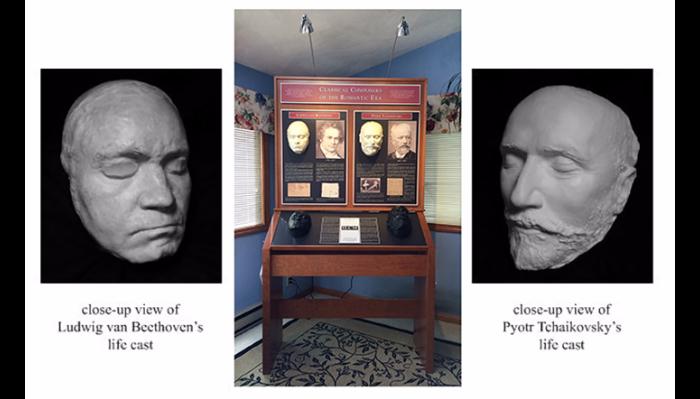
We want to take it a step further, and provide free-standing exhibit modules for each school. The school will initially receive the rosewood module that will permanently remain in their facility. Along with that, one paired-up exhibit of historical figures. Each exhibit includes: a header panel that presents the paired-up historical figures; side by side wall panels with the featured exhibit write-ups and supporting images and white resin casts that easily attach; a waist level dashboard and another copy of each cast in black resin which is strategically placed for touch. For the exhibits we have paired-up historical figures including: Beethoven & Tchaikovsky, Edison & Tesla, Grant & Lee.
All panels are easily interchangeable, and they are attached and removed with the Velcro backing. The casts have a wood backing and a U-bolt embedded in it in order to easily slide into each panel, no tools needed. The goal is to have these paired-up exhibits rotate on an annual basis for each new school year.
With feedback from staff and students at the Perkins School for the Blind in Watertown, MA, the dashboard display area is on the correct incline for touching the black resin casts, and the area is high and deep enough for wheelchair accessibility. Braille plastic labels identify each black resin face on the dashboard. Braille versions of the wall exhibit write-ups hang in folders on either side of the module.The wall panel text is an over-sized font with white type on a black background, for easier viewing for those that are visually impaired but can still read. Lights are included that spot the exhibit from above the module. Lastly, audio files of each exhibit write-up are available through smart phone technology. The module you see in the photo above is now installed at Perkins School for the Blind.
Our ultimate goal is to provide these module fixtures and annual rotating exhibits for all 30 schools, that are interested in having the installation. For now, we are taking smaller steps, and beginning with the installation of five modules as soon as these funds are in place. Any contribution is helpful and we thank you in advance for doing your part to bring history to life!
Did you know?
Even if you can't contribute with money, you can help this campaign by sharing on Facebook! In fact, when this campaign reaches 100 shares on Facebook and $1000 raised, FreeFunder will donate $20 to it. Tell your friends! Currently this campaign has been shared on Facebook about 23 times.
FreeFunder allows fundraisers to create free personal crowdfunding campaigns, with no platform fees!