 Byron Center, MI
 Adoption
Private
This campaign has ended and is no longer accepting donations.
Hope's Sibling
In 2013, after Heather and I had been married two years, we moved from Dowagiac, MI, to Grand Rapids, MI, to be closer to our family and to pursue new jobs. We thought it was a good time to start a family. We were already in our mid-30s, and we knew that as women age from 30 to 35 to 40, the likelihood of getting pregnant goes way down.
We tried to have a child for a year with no success. In early 2014, Heather went in to see her ObGyn, but the doctor wasn't very concerned. She recommended some nutritional supplements.
After several more months passed, it became clear that even with better nutrition, we still couldn't seem to get pregnant. Heather decided to make an appointment with the West Michigan Fertility clinic. This was in 2015. For a year, Dr. Dodds at West Michigan Fertility gave us a variety of treatments, including fertility drugs and intrauterine insemination. Nothing worked, and we were fast running out of options. I was 37, and Heather was 42. Dr. Dodds told us that our final option was in vitro fertilization (IVF), but due to Heather's age we only had a 5-8% of getting pregnant. And because IVF was very expensive, he didn't recommend it. This was heartbreaking news, especially for Heather, who had a deep yearning to be pregnant and to give birth to a baby.
I'll come back to the rest of our story later, but for now let me tell you a bit about the science of IVF. For In vitro fertilization, the lab will make as many embryos as possible, sometimes as many as 20 or 30. Then they will freeze them and store them in a subzero freezer. This process is called cryopreservation. In 2020 an embryo that had been frozen for 27 years was successfully implanted in a woman's uterus. Nine months later the little girl was born!
We humans were so eager to develop IVF—which really is amazing, a miracle of science that has enabled infertile couples all over the world to have families—that we didn't think through all of the ramifications. One of those ramifications is the creation of “extra" embryos. If a family makes 20 embryos, for example, they aren't going to use them all, even if their fertility doctor implants them two or three at a time (which is what doctors used to do; that's why there have been so many twins and triplet births). According to a 2019 article in the New York Times, the estimated total number of embryos sitting in freezers all across the United States is between 600,000 to one million. That's one million lives just waiting to be born.
So what should we do with all these “extra” embryos? Wouldn't stem cell research be an excellent use for them?
In 2006, George W. Bush vetoed a bill that would provide further federal funding for embryonic stem cell research. Talking about all these frozen embryos, Bush said, “These children are not spare parts.” These embryos are in fact little children, frozen on ice, waiting for a chance to be implanted into someone's womb and to be born.
The first couple in the United States to adopt one of these “extra embryos” was Marlene and John Strege. In 1997, after having gone through years of infertility, Marlene asked her fertility doctor if it would be possible to adopt one of these “extra embryos” left over from IVF. The doctor said no one had ever asked him before, and he would have to look into it.
In the meanwhile, the Streges earnestly prayed. They sought God with a heartfelt question: is the adoption of embryos good in Your sight? They also contacted four Christian leaders, including James Dobson, the founder of Focus on the Family, to ask their opinion. Marlene said that “ultimately, everyone with whom we made contact confirmed what we already knew: that embryos are human lives and they need to be adopted in the event that families responsible for their creation are unable to use them.”
Meanwhile, the Streges' fertility doctor discovered the Streges could adopt someone's embryo, but they would need the help of an adoption agency. So, they got in contact with Nightlight Christian Adoption, and the practice of embryo adoption in the United States was born. Hannah Strege, the very first baby ever to be born in the United States through embryo adoption, was born on December 31, 1998.
So let me pick up Heather and my story where I left off. When Dr. Dodd's told us that embryo adoption could be an option for us, we had the same kinds of questions that the Streges did. "What does God think about all this?" "Aren't we stepping into God's domain by tampering with the conception and pregnancy process?" After praying, the idea came to Heather and me that we wanted to become the answer to someone's prayer that their donated embryos would not be discarded but rather adopted by a good family.
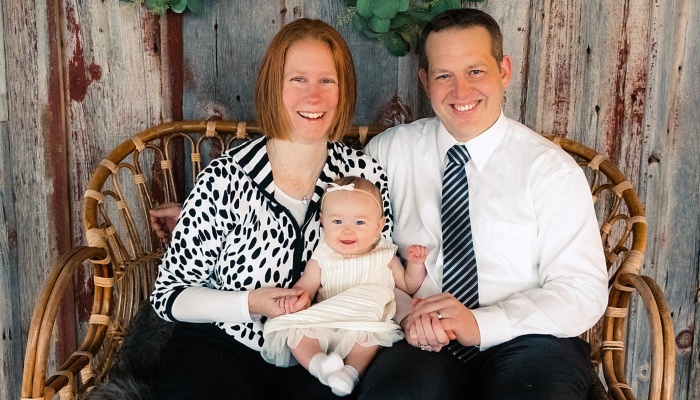
That decision has led Heather and me on a difficult and yet amazing journey. On May 4, 2017, Heather had two donor embryos transferred into her uterus. The transfer failed; neither embryo implanted. Three months later, we tried again with the final embryo from the set of three that we'd adopted. That transfer also failed. We faced a crisis of faith—after being so sure that God had led us down this road, we (and especially me) began to doubt that God wanted us to have a child in this way. After more prayer, we found a new fertility doctor, Dr. Laura Gago in Brighton, MI. On the force of Heather's resolution that we should not give up until we became too old to try (Heather was now 43), we looked for another set of embryos to adopt. After a year-long process, we adopted a set of six beautiful, 5-day old embryos from Cedar Park Embryo Adoption Services in Washington State. And on August 26, 2019, Dr. Gago implanted one of these embryos into Heather's uterus. 8 days later we found out we were pregnant! And on Mother's Day of 2020, Hope Evelyn Nagelkerk Den Houter was born! The fact that she came on Mother's Day was a sign to us that God had heard our YEARS of prayers.
Now Heather and I would like to try to implant another from this set of six embryos, which, if successful, would provide Hope a biological sibling! We ask for your prayers for God to bless us again with a child. We also would appreciate donations, for the medications that Heather has to take to prepare her uterus are not covered by our insurance, and the embryo transfer is expensive. Thank you in advance for your support on our journey!
The words of Psalm 27:13-14 are filled with meaning for us now: "I believe that I shall look upon the goodness of the Lord in the land of the living! Wait for the Lord; be strong, and let your heart take courage; wait for the Lord!" May these verses encourage your hearts just as they have encouraged ours.
Did you know?
Even if you can't contribute with money, you can help this campaign by sharing on Facebook! In fact, when this campaign reaches 100 shares on Facebook and $1000 raised, FreeFunder will donate $20 to it. Tell your friends! Currently this campaign has been shared on Facebook about 5 times.
FreeFunder allows fundraisers to create free personal crowdfunding campaigns, with no platform fees!